Defining the structure for centroid buoyancy calculations
The Structure Definition form (1D model > Pore Pressure > Centroid Buoyancy) enables you to enter all formation and fluid data necessary for Centroid Buoyancy calculations. The table consists of an upper and a lower table, for Target formation definition and Fluid column definition, respectively.
When you first open the model, a blank target definition is available. You enter the MD or TVDSS start and stop depths of the wellbore intersection with the formation, and the structure top and base for each formation.
By default, formations are presented as water-saturated throughout. You can add gas and oil columns by selecting a formation in the upper table (its row turns blue) and editing the Column Height and Fluid Density values in the table at the bottom of the window. You may also do this selecting the Show all box, to define for each formation the height and density of the fluids.
After you enter all values, the application calculates the centroid of the fluid-filled zones and adjusts the pore pressure in the wellbore to account for buoyancy effects.
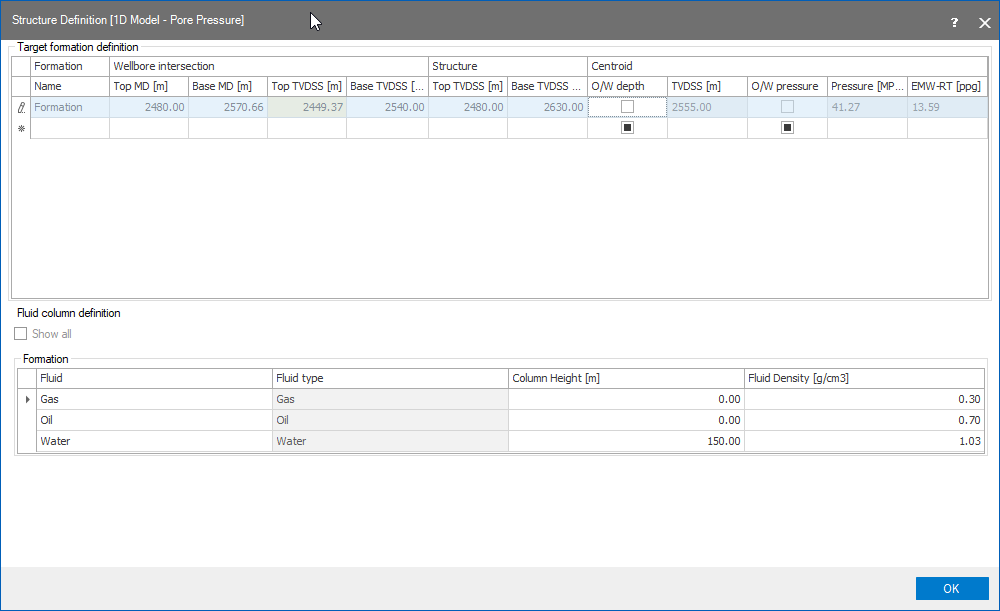
The Structure Definition form for the Centroid Buoyancy calculation, the fluid column definition and centroid pressures can be specified in this form click to enlarge
Formation
Name Name of the formation in which centroid buoyancy is calculated. The Buoyancy Model can contain several formations that might or might not belong to one and the same hydrocarbon pressure regime, i.e. share the same hydrocarbon water contact. Enter a name and data in the blank table row. A new row is added automatically. As long as not all data for a specific formation been entered in the table, the background of the row’s entry fields is pink.
Wellbore intersection
Top MD MD depth at which the well intersects the top of the formation.
Base MD MD depth at which the well intersects the base of the formation.
Top TVDSS TVDSS depth at which the well intersects the top of the formation.
Base TVDSS TVDSS depth at which the well intersects the base of the formation.
Structure
Top TVDSS TVDSS depth of the top (apex) of the structure in which hydrocarbons are contained.
Base TVDSS TVDSS depth of the structure’s closure depth, i.e. the structure’s lowest point at which hydrocarbons can start leaking away.
Centroid
O/W Depth Overwrite centroid depth. If this box is unchecked, O/W centroid depth is taken from the settings in the table, as the value halfway between the top and the base of the structure. By default the box is not checked. However, if you have reliable calibration points (pore pressure measurements) and you think these should give better results, you can overwrite the default value. Check the box and enter a value from the calibration points in the next column.
TVDSS TVDSS depth value for the Centroid point.
Centroid TVDSS TVDSS depth value for of the centroid point.
O/W Pressure Overwrite centroid pressure. If this box is unchecked, O/W centroid pressure is calculated from the settings in the table. By default the box is not checked. However, if you have reliable calibration points (pore pressure measurements) and you think these should give better results, you can overwrite the calculated value. Check the box and enter a value from the calibration points in the next column.
Pressure Pore pressure value at Centroid depth.
EMW-RT Equivalent Mud Weight at Centroid depth.
In the lower table you enter the fluid properties of the selected formation.
Fluid Name of the fluid.
Fluid Type Name of the fluid template that is applied (read-only).
Column Height Thickness of the fluid layers in the whole formation. By default the formation is considered to be fully water bearing. Enter the height of the oil and/or gas column. The height of the water column adjusts automatically. If more than one fluid is present, the sum of the fluid column heights cannot be more than the thickness of the formation. If the sum of the oil and gas heights exceeds this thickness, a warning is issued.
Fluid Density Density of the fluid at reservoir conditions.